
www.waterplant.tech
06
'26
Written on Modified on
Bürkert Improves Chlorine Monitoring for Veolia RO Systems
Online analysis was introduced to prevent membrane damage and maintain zero-chlorine conditions in pharmaceutical and food water treatment.
www.buerkert.de
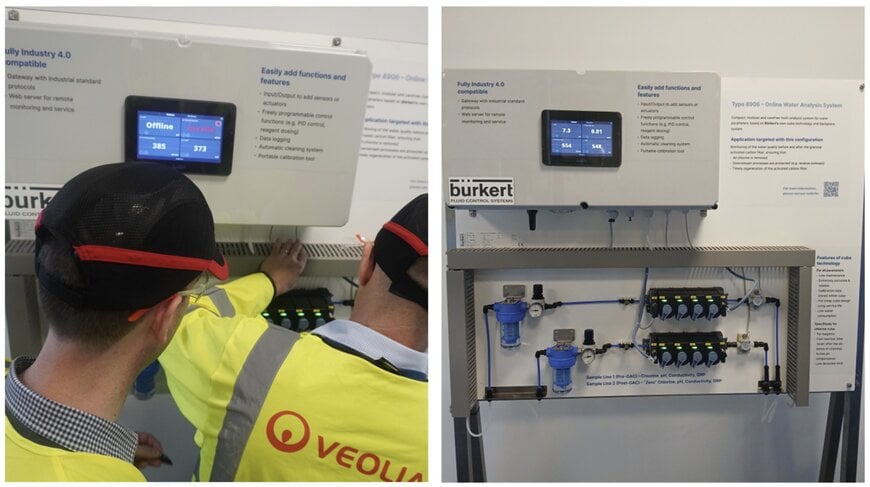
Bürkert's Online Water Analysis offers precision monitoring of several parameters, including chlorine, ORP, pH and temperature.
In pharmaceutical and food & beverage water treatment, reverse osmosis plays a central role in producing purified process water. At its training and demonstration facility near Dublin, Veolia Water Technologies Ireland needed a more reliable way to monitor chlorine and protect reverse osmosis membranes from chemical degradation.
The site operates a granular activated carbon (GAC) filtration stage upstream of its RO system to remove residual disinfectants from mains or treated borehole water. Although the GAC units are designed for dechlorination, breakthrough events can occur during operational disturbances such as backwashing and rinsing. Even low chlorine exposure contributes to cumulative membrane damage, typically limited to around 1,000 ppm-hours over a membrane’s lifetime. Continuous, fast-response chlorine monitoring was therefore required to ensure membrane protection and support stable operation of the facility’s industrial water treatment processes.
Limitations of existing chlorine measurement methods
Previous monitoring approaches relied on reagent-based testing and conventional amperometric probes. Reagent methods were not suited to continuous measurement and required ongoing chemical handling and operator time. Traditional amperometric electrodes demanded frequent maintenance and recalibration and were susceptible to signal drift, particularly when chlorine was absent for extended periods downstream of GAC filtration.
This polarisation effect, caused by film formation or residual ion build-up on the electrode surface, could delay or suppress the sensor’s response when chlorine reappeared. Less frequent manual testing, such as hourly sampling, was insufficient to detect short breakthrough events that could still shorten membrane life.
Deployment of an online water analysis platform
To identify a more robust solution, Veolia commissioned Bürkert to install and evaluate its Type 8906 Online Water Analysis System. The system was equipped with an MS02 chlorine sensor and an MS04 oxidation-reduction potential (ORP) sensor, enabling direct comparison between chlorine-specific and indirect oxidant monitoring.
The MS02 sensor uses a single-membrane design over a MEMS sensing element, reducing diffusion resistance and enabling a T90 response time below 30 seconds. By contrast, typical amperometric chlorine sensors reach T90 in around 120 seconds. The MS02 also incorporates an integrated electrode block that maintains a stable reference, preventing polarisation during extended chlorine-free operation.
The ORP sensor provided a secondary indication of oxidising species, typically associated with chlorine at around 650 mV, but without the ability to quantify chlorine concentration directly.
Performance during inlet and post-filtration trials
Testing began in October 2024, initially monitoring chlorine upstream of the GAC filters where higher concentrations were expected. The MS02 chlorine sensor detected chlorine significantly faster than the ORP probe. During one period, the ORP sensor did not register chlorine presence below 650 mV for three hours, and in a later phase, failed to detect fluctuating chlorine levels over a 20-hour interval when readings varied between 0 and 300 mV. Although concentrations were low, prolonged exposure at these levels could still contribute to membrane wear.
Downstream of the GAC system, a backwash event caused a temporary chlorine breakthrough. The monitoring system enabled the affected stream to be diverted to drain before reaching the RO membranes. The time difference between sensor responses was smaller than at the inlet, but the delay observed with ORP-only monitoring would have allowed chlorine to reach the membranes. In systems using electrodeionisation instead of RO, even concentrations as low as 0.05 ppm could cause damage, underlining the need for rapid, chlorine-specific detection in reverse osmosis monitoring.
Operational integration and outcomes
The Type 8906 system provides real-time alarms and visual alerts when chlorine is detected. A 7-inch touchscreen displays live process values, and integrated data logging supports retrospective analysis of operating conditions and events.
Following the study, Veolia Water Technologies Ireland adopted the online system as a means of preventing chlorine ingress into its RO stages. The approach strengthens membrane protection, reduces reliance on reagent handling and manual sampling, and provides continuous documentation of dechlorination performance across operating cycles.
www.burkert.com
In pharmaceutical and food & beverage water treatment, reverse osmosis plays a central role in producing purified process water. At its training and demonstration facility near Dublin, Veolia Water Technologies Ireland needed a more reliable way to monitor chlorine and protect reverse osmosis membranes from chemical degradation.
The site operates a granular activated carbon (GAC) filtration stage upstream of its RO system to remove residual disinfectants from mains or treated borehole water. Although the GAC units are designed for dechlorination, breakthrough events can occur during operational disturbances such as backwashing and rinsing. Even low chlorine exposure contributes to cumulative membrane damage, typically limited to around 1,000 ppm-hours over a membrane’s lifetime. Continuous, fast-response chlorine monitoring was therefore required to ensure membrane protection and support stable operation of the facility’s industrial water treatment processes.
Limitations of existing chlorine measurement methods
Previous monitoring approaches relied on reagent-based testing and conventional amperometric probes. Reagent methods were not suited to continuous measurement and required ongoing chemical handling and operator time. Traditional amperometric electrodes demanded frequent maintenance and recalibration and were susceptible to signal drift, particularly when chlorine was absent for extended periods downstream of GAC filtration.
This polarisation effect, caused by film formation or residual ion build-up on the electrode surface, could delay or suppress the sensor’s response when chlorine reappeared. Less frequent manual testing, such as hourly sampling, was insufficient to detect short breakthrough events that could still shorten membrane life.
Deployment of an online water analysis platform
To identify a more robust solution, Veolia commissioned Bürkert to install and evaluate its Type 8906 Online Water Analysis System. The system was equipped with an MS02 chlorine sensor and an MS04 oxidation-reduction potential (ORP) sensor, enabling direct comparison between chlorine-specific and indirect oxidant monitoring.
The MS02 sensor uses a single-membrane design over a MEMS sensing element, reducing diffusion resistance and enabling a T90 response time below 30 seconds. By contrast, typical amperometric chlorine sensors reach T90 in around 120 seconds. The MS02 also incorporates an integrated electrode block that maintains a stable reference, preventing polarisation during extended chlorine-free operation.
The ORP sensor provided a secondary indication of oxidising species, typically associated with chlorine at around 650 mV, but without the ability to quantify chlorine concentration directly.
Performance during inlet and post-filtration trials
Testing began in October 2024, initially monitoring chlorine upstream of the GAC filters where higher concentrations were expected. The MS02 chlorine sensor detected chlorine significantly faster than the ORP probe. During one period, the ORP sensor did not register chlorine presence below 650 mV for three hours, and in a later phase, failed to detect fluctuating chlorine levels over a 20-hour interval when readings varied between 0 and 300 mV. Although concentrations were low, prolonged exposure at these levels could still contribute to membrane wear.
Downstream of the GAC system, a backwash event caused a temporary chlorine breakthrough. The monitoring system enabled the affected stream to be diverted to drain before reaching the RO membranes. The time difference between sensor responses was smaller than at the inlet, but the delay observed with ORP-only monitoring would have allowed chlorine to reach the membranes. In systems using electrodeionisation instead of RO, even concentrations as low as 0.05 ppm could cause damage, underlining the need for rapid, chlorine-specific detection in reverse osmosis monitoring.
Operational integration and outcomes
The Type 8906 system provides real-time alarms and visual alerts when chlorine is detected. A 7-inch touchscreen displays live process values, and integrated data logging supports retrospective analysis of operating conditions and events.
Following the study, Veolia Water Technologies Ireland adopted the online system as a means of preventing chlorine ingress into its RO stages. The approach strengthens membrane protection, reduces reliance on reagent handling and manual sampling, and provides continuous documentation of dechlorination performance across operating cycles.
www.burkert.com
