
www.waterplant.tech
29
'26
Written on Modified on
Alfa Laval spiral heat exchangers improve biogas energy efficiency
Spiral heat exchangers increase power generation efficiency and support circular wastewater treatment operations in Southern California.
www.alfalaval.com
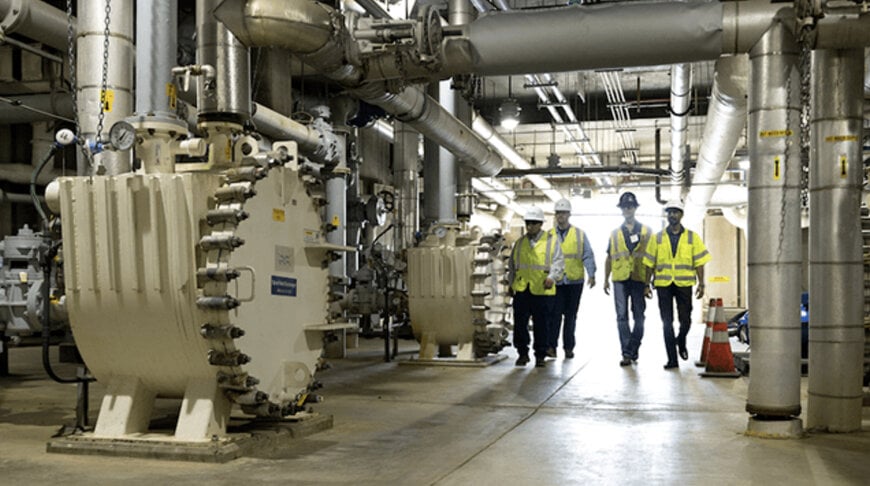
Alfa Laval has deployed spiral heat exchanger technology at Orange County Sanitation District to improve energy recovery from wastewater treatment processes, enabling higher efficiency biogas utilization and reduced external energy demand.
The implementation is part of ongoing upgrades at the Huntington Beach treatment facility, where anaerobic digestion is used to convert sludge into methane-rich biogas for on-site electricity generation.
Thermal control in anaerobic digestion
The spiral heat exchangers are used to maintain stable temperature conditions in anaerobic digesters, where sludge is processed over 18 to 21 days at approximately 36°C. Consistent thermal conditions are required to sustain microbial activity responsible for biogas production.
Compared to previously used cube-type heat exchangers, the spiral design provides improved heat transfer efficiency, enabling more effective temperature control under high-solids conditions typical of sludge processing.
Increased energy recovery from biogas
The digestion process produces methane biogas, which is captured, compressed, and used to fuel engine generators. These generators supply more than 60 percent of the facility’s total energy demand.
Improved thermal efficiency contributes to higher biogas yield and more stable generation conditions. The plant produces an average of 7.1 kilowatt-hours of energy monthly per operational unit, resulting in annual energy cost savings of approximately US$ 6.2 million by reducing reliance on grid electricity.
Equipment design and maintenance advantages
The spiral heat exchangers have a footprint approximately one-third the size of conventional cube-type systems, reducing space requirements in a region where land costs are significant. The compact design allows easier integration into existing infrastructure.
Maintenance access is simplified through a hinged cover design, enabling faster cleaning and inspection. Compared to conventional systems, cleaning time is reduced by a factor of three to four, improving equipment availability and reducing maintenance downtime.
Application in large-scale wastewater treatment
Orange County Sanitation District manages wastewater treatment for approximately 2.6 million people across a 1,240 km² service area. The Huntington Beach facility processes over 268,000 cubic meters of wastewater per day.
Integration of energy recovery systems within treatment operations supports circular process design, where waste streams are converted into usable energy. This reduces operational costs and contributes to system resilience under increasing water demand and energy constraints.
Role in circular infrastructure systems
The deployment demonstrates how heat transfer optimization can improve the efficiency of anaerobic digestion and energy recovery processes. By increasing the conversion of waste into energy, the system supports circular infrastructure models in municipal utilities.
The cooperation between Alfa Laval and Orange County Sanitation District illustrates how process-level improvements in thermal management can enhance both operational performance and resource utilization in wastewater treatment facilities.
Edited by Natania Lyngdoh, Induportals Editor — Adapted by AI.
www.alfalaval.com
