
www.waterplant.tech
23
'26
Written on Modified on
Integrated Water and Wastewater Services in Coastal Occitanie
SUEZ renews a long-term service contract with the Hérault Méditerranée Urban Community to strengthen water security, sanitation performance, and resource efficiency.
www.suez.com
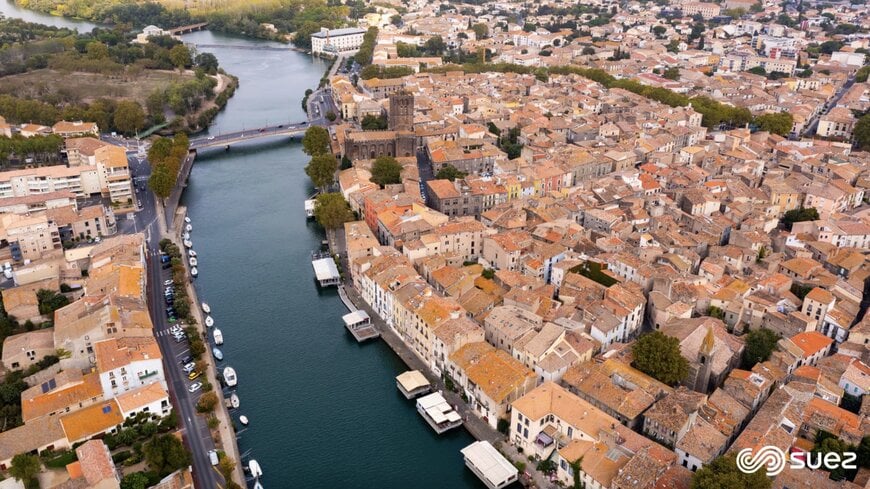
SUEZ has renewed its contract with the Hérault Méditerranée Urban Community to operate drinking water, sewerage, and on-site sanitation services for 15 years, combining infrastructure investment, energy recovery, and digital water management in a region exposed to chronic water stress.
Contract scope and governance framework
Starting on July 3, 2026, SUEZ will operate water and wastewater services for the Hérault Méditerranée Urban Community through a dedicated operating company, with financial support from Banque des Territoires. The agreement covers drinking water production and distribution, sewerage, and on-site sanitation services over a 15-year period.
The contract reflects long-term planning in a coastal territory characterised by limited water availability, high seasonal population variability linked to tourism, and environmentally sensitive ecosystems. Nearly €55 million in planned investments underpin the service model, supported by a local governance structure and a workforce of 44 employees.
Sanitation infrastructure and energy recovery
Sanitation infrastructure is positioned as a contributor to regional energy transition objectives. At the Posidonia wastewater treatment plant serving the cities of Agde and Vias, a €14 million investment will enable the installation of an anaerobic digester for sludge treatment and energy recovery.
The system is designed to accommodate strong seasonal variations in wastewater flows while optimising biogas production. From 2029, the facility is expected to generate 3.6 GWh of biomethane annually, which will be injected into the GRDF network. This output corresponds to the annual gas consumption of approximately 570 households, contributing to energy sovereignty in Occitanie.
Wastewater reuse as a resource management tool
Treated wastewater reuse is a central element of the renewed contract. Since 2020, recycled water has been used to irrigate the Agde golf course, avoiding the annual abstraction of around 200,000 m³ of drinking water.
Under the new agreement, reuse volumes will increase to up to 600,000 m³ per year of treated wastewater meeting Class A+ quality standards. This includes 200,000 m³ for golf course irrigation and additional volumes for network flushing, street cleaning, and fire and rescue operations. From 2033, recycled water will also be used for hull maintenance at the Port of Cap d’Agde, irrigation of the rugby stadium, and vehicle cleaning at the municipal technical centre.
To achieve the required water quality, the Posidonia plant’s existing membrane ultrafiltration line will be complemented by combined chlorine and ultraviolet (UV) disinfection, enhancing pathogen removal and operational robustness.
Drinking water services and demand management
SUEZ will continue to supply and distribute drinking water to approximately 18,000 users across the Urban Community. The territory has adapted its water management model to sustained pressure on resources, including the introduction of one of France’s first seasonal water tariffs in 2014 to balance tourist demand, infrastructure financing, and summer water conservation.
More than fifteen years of continuous investment have resulted in infrastructure capable of responding to climate change impacts while maintaining service continuity during peak demand periods.
Digital metering and network performance
The rollout of next-generation smart meters in the municipalities of Nézignan-l'Evêque and Saint-Pons-de-Mauchiens in 2026 will enable full remote meter reading for users. Through a dedicated application, customers will be able to monitor monthly consumption, detect leaks earlier, and better manage billing.
In Occitanie, SUEZ’s remote meter reading systems identified over 33,500 suspected leaks in 2025, reducing water losses and associated costs. At network level, tailored action plans will be implemented in each municipality to reduce leakage and unauthorised consumption.
Measures include real-time monitoring via the Aquadvanced platform, pressure management in selected zones, renewal of 21 km of pipelines and 1,950 service connections, deployment of 550 fixed acoustic sensors, annual leak detection campaigns across 240 km of network, and targeted camera inspections. Collectively, these actions are intended to raise network efficiency above 91% by the end of the contract and save an estimated 3 million m³ of water.
Application context
The renewed contract illustrates how integrated water and wastewater management, combined with digital tools and energy recovery, can address the combined challenges of water scarcity, seasonal demand, and climate resilience. For coastal territories within the Occitanie region, the model links operational performance with long-term resource protection and local energy production.
www.suez.com
