
www.waterplant.tech
03
'26
Written on Modified on
Low NPSH Pump Design for Cavitation Control
National Pump Company outlines engineering strategies that reduce cavitation risk in high-temperature and constrained suction applications.
www.nationalpumpcompany.com
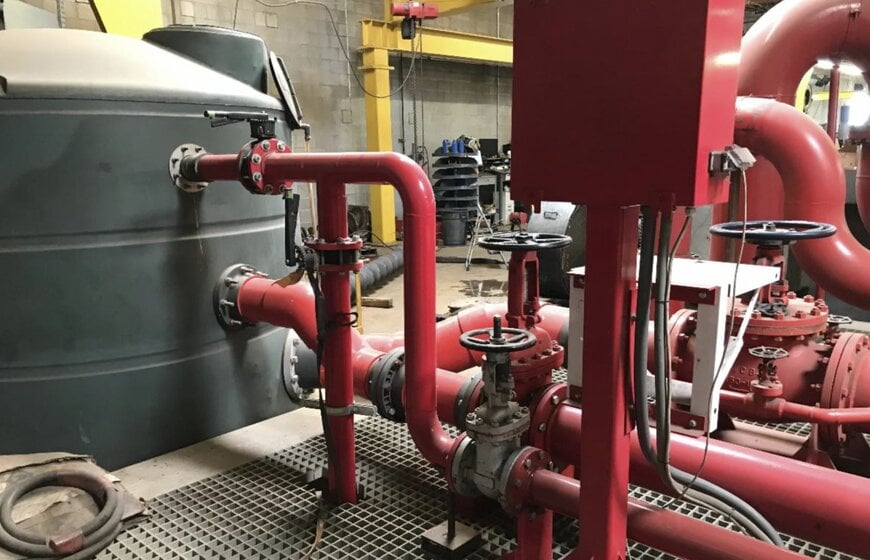
Cavitation remains a recurring constraint in industrial pumping systems, particularly in power generation, condensate handling and high-vapor-pressure services. When inlet pressure drops near a liquid’s vapor pressure, vapor cavities form and collapse inside the pump, leading to vibration, noise and long-term material erosion. In this context, Kenric Freiwald, Product Development Engineer at National Pump Company, details how low Net Positive Suction Head (NPSH) pump designs can mitigate risk by reducing the suction head required for stable operation.
Cavitation Begins at the System Level
Net Positive Suction Head describes whether the pressure at the pump inlet is sufficient to keep the liquid in a fully liquid state. It is expressed as head because it incorporates static liquid level, fluid velocity, temperature and friction losses.
Two parameters define the operating margin. Net Positive Suction Head Required (NPSHr) is determined by pump testing under controlled conditions. It is typically referenced to the point at which total head drops by three percent due to cavitation, known as NPSH₃, in accordance with ANSI/HI standards and Hydraulic Institute guidance. Net Positive Suction Head Available (NPSHa) represents the pressure the system can deliver to the pump inlet after accounting for elevation, temperature and losses.
When NPSHa approaches NPSH₃, hydraulic instability begins. Efficiency declines before mechanical damage becomes visible. The root cause is often system configuration rather than pump failure, including optimistic assumptions about liquid level, piping losses or temperature fluctuations.
Why Low NPSH Designs Matter in High-Vapor-Pressure Service
Applications involving high-temperature condensate or fluids with elevated vapor pressure leave a limited margin before vapor formation occurs. In steam-turbine power plants, for example, condensers operating under deep vacuum can cause water to boil near 90°F, significantly limiting NPSHa.
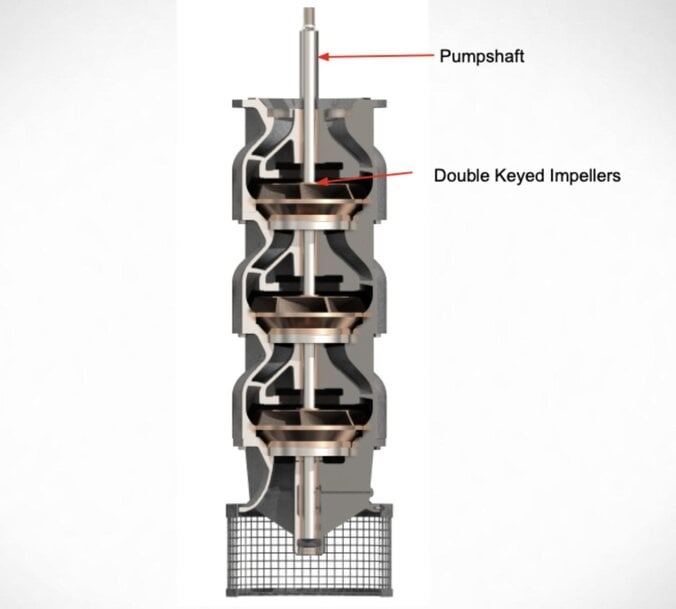
Vertical turbine pumps provide an inherent structural advantage in these scenarios. By placing the impeller deeper below the liquid surface, static head increases at the inlet. Traditionally, increasing suction head required longer pump columns and deeper pits.
Low NPSH impeller designs reduce the pump’s NPSHr instead. By lowering the suction head required to avoid cavitation, the same hydraulic duty can be achieved with reduced installation depth. This affects not only hydraulic stability but also excavation requirements, foundation size and long-term maintenance access.
Similar principles apply in high-head snowmaking systems, where pumps draw from shallow ponds and must generate substantial discharge pressure without losing inlet stability.
Engineering NPSHr Reduction at the Impeller
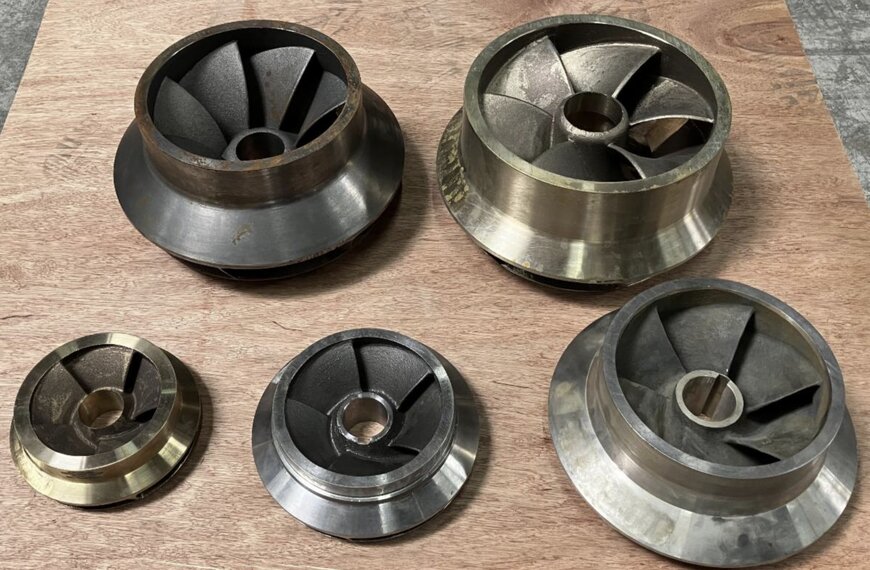
Reducing NPSHr depends on how fluid enters and accelerates through the impeller eye. Parameters such as inlet vane geometry, eye diameter and flow path smoothness influence local pressure drop. In multistage vertical turbine pumps, National Pump Company applies a low NPSH design to the first stage while subsequent stages optimize head and efficiency.
Development combines analytical modeling with iterative testing. Rapid prototyping methods, including 3D-printed sand cores for casting impellers, allow refinement of inlet geometry before final tooling.
Material selection also influences durability in cavitation-prone service. Low NPSH vertical turbine pumps are frequently produced in 316 stainless steel, providing corrosion resistance and mechanical strength for high-temperature condensate and aggressive water chemistries. Compared with traditional bronze, 316 stainless steel offers improved performance under thermal cycling and varying water quality.
Mechanical attachment methods contribute to reliability. Keyed impeller connections provide positive torque transmission between the shaft and the impeller. In contrast to friction-based collet-style mounts, keyed designs maintain alignment and torque under transient loads and temperature variations common in cavitation-sensitive systems.
From Calculation to Operating Reality
NPSH calculations are often misinterpreted. NPSH is referenced from absolute pressure, not gauge pressure. Confusion between the two can result in overstated NPSHa values and under-designed systems. While NPSHr is verified through testing, NPSHa remains an estimate based on design assumptions. Conservative margin above NPSH₃ is therefore critical.
Condition monitoring tools, including vibration sensors, are increasingly used to detect early hydraulic instability. These systems provide feedback on real operating margins and support more accurate pump selection in future projects.
National Pump Company’s low NPSH vertical turbine offerings cover bowl sizes from 8 to 24 inches, and flow ranges from 100 to 12,000 gallons per minute. Development programs include the KK10LS, targeting approximately 800 to 1,200 gallons per minute with planned availability by the end of the first quarter of 2026 and shipments by the end of the second quarter, and the DH16FS, aimed at 4,500 to 6,000 gallons per minute with anticipated release in 2027.
Designing for Margin Rather Than Minimum
Low NPSH pump technology reflects a broader engineering principle: reliable systems operate with margin rather than at theoretical limits. By reducing NPSHr and maintaining practical clearance above NPSH₃, engineers gain flexibility in installation depth, lifecycle cost management and adaptation to changing operating conditions.
In high-temperature and constrained-suction environments, this approach reframes cavitation from an unavoidable risk to a controllable hydraulic parameter addressed through targeted impeller design and system-level integration.
www.nationalpumpcompany.com
