
www.waterplant.tech
12
'26
Written on Modified on
GEA Advances Intelligent Decanter Control for Wastewater Plants
Upgraded autonomous sludge dewatering system targets lower polymer use and higher process efficiency.
www.gea.com
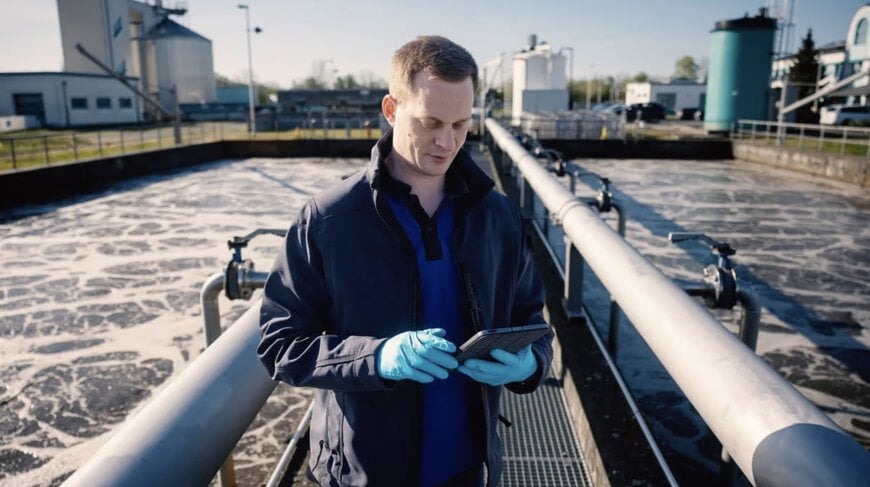
GEA Group presented an upgraded version of its OptiPartner Intellicant system for wastewater treatment at the IFAT 2026 (May 4–7) in Munich, Germany. The digital platform combines real-time sensors, autonomous control software, and cloud-based analytics to convert decanter centrifuges into self-optimizing sludge dewatering systems for municipal wastewater treatment plants.
Originally introduced in 2023, Intellicant is designed to address increasing operational pressure on wastewater infrastructure, including fluctuating sludge characteristics, rising disposal costs, water stress, and workforce shortages. The system continuously monitors sludge conditions and automatically adjusts process parameters to maintain stable separation performance and optimize dry solids content.
Real-time process control for sludge dewatering
Wastewater treatment plants operate under highly variable conditions influenced by rainfall, industrial discharge, temperature shifts, and changing sewage composition. These fluctuations can rapidly alter sludge characteristics, requiring operators to manually adjust polymer dosing, differential velocity, and tank depth to maintain efficient dewatering performance.
Intellicant replaces reactive process adjustments with autonomous control. The platform continuously measures three critical process parameters: feed solids concentration, centrate turbidity, and discharged sludge dry solids content. This sensor data is transmitted through a local network connection to a software layer referred to as the “Virtual Operator,” which automatically adapts decanter operating conditions in real time.
The system integrates into existing plant control infrastructure and is available both for new decanter centrifuges and as a retrofit kit for installed GEA environmental decanters. It is offered as a subscription-based digital service including performance monitoring, reporting, and continuous optimization tools.
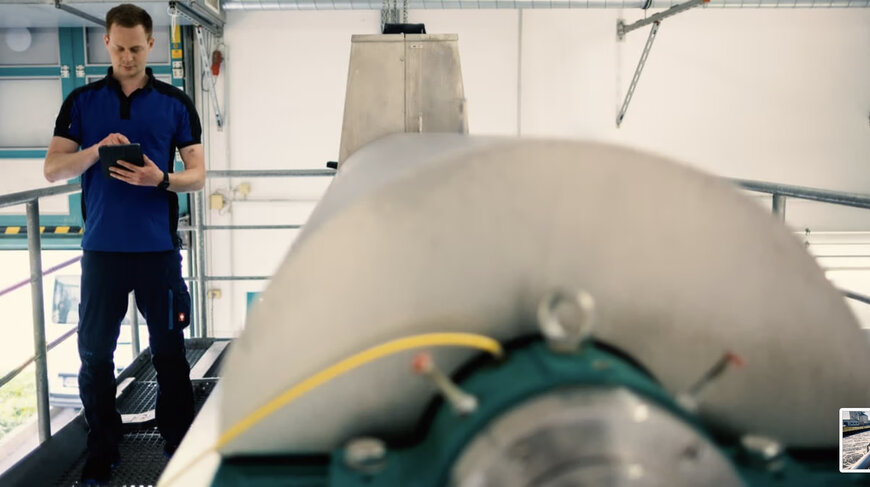
The GEA OptiPartner® Intellicant® system for intelligent wastewater management is in use at the wastewater treatment plant in Parthe, Germany. (Photo: GEA/Parthe Wastewater Treatment Plant)
Configurations for stability, polymer reduction, and dry solids optimization
GEA offers Intellicant in three operational configurations targeting different wastewater management priorities.
The Core Kit focuses on process stability by automatically regulating polymer dosing under fluctuating sludge conditions. The Edge Kit prioritizes reduced polymer consumption while maintaining separation performance, while the Peak Kit maximizes sludge dry solids content to lower transport and disposal volumes.
According to GEA, every percentage point increase in dry matter content can reduce annual sludge disposal costs by approximately €135,000 in a wastewater treatment plant serving 385,000 population equivalents, based on disposal costs of €60 per ton of dry matter.
The company stated that the autonomous system supports higher dry solids values, lower polymer usage, reduced operator intervention, and improved process reliability across wastewater treatment operations.
Wastewater sector faces operational and environmental pressures
The development comes as wastewater treatment operators face growing regulatory and operational demands. In Germany, sewage sludge volumes increased by 2% in 2024 compared to 2023, reversing several years of decline. The increase corresponds approximately to the annual sewage sludge output of a city with one million inhabitants.
At the same time, agricultural reuse of sewage sludge continues to decline. According to data referenced by GEA from Germany’s Federal Statistical Office (Destatis), only 12% of municipal sewage sludge was used as agricultural fertilizer in 2024, compared with 30% in 2009. Thermal utilization increased to 82%, with sludge increasingly incinerated for energy and heat generation.
These trends are increasing demand for efficient sludge dewatering technologies that reduce transport volumes, polymer consumption, and disposal costs while improving operational resilience within the digital supply chain of water infrastructure management.
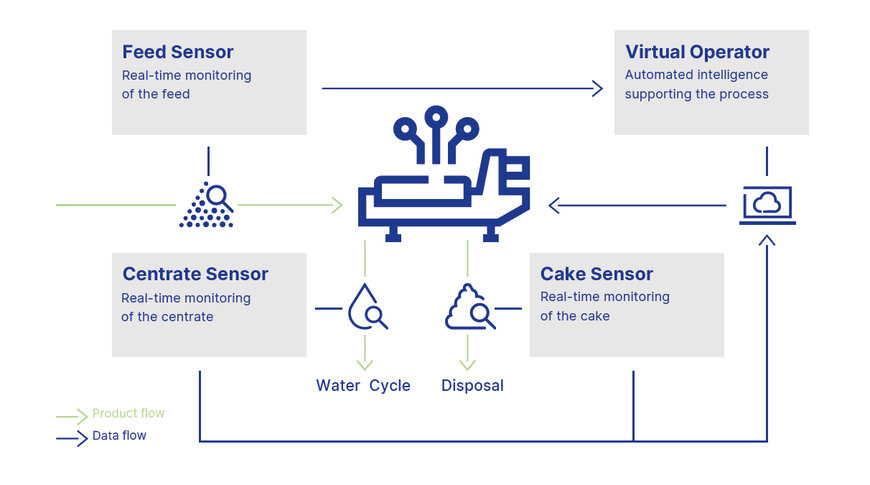
How Intellicant keeps the decanter at its optimal operating point: Three types of sensors measure critical process data; the Virtual Operator immediately evaluates the data and controls the decanter for optimal performance. (Graphic: GEA)
Field deployments demonstrate operational savings
Several wastewater treatment facilities in Germany reported measurable operational improvements during Intellicant deployments.
At the Oldenburg wastewater treatment plant, the Intellicant Edge Kit reduced polymer consumption by 11% during a two-month trial while maintaining stable separation performance. The facility processes approximately 100 tons of polymer annually, resulting in a projected payback period of between 1.5 and 2 years.
The Geseke wastewater treatment plant reported polymer consumption reductions of between 25% and 28% after implementing the system. Plant operators also cited improved process transparency through historical operational data analysis, enabling more stable downstream biological treatment processes.
At the Parthe wastewater treatment plant in Borsdorf, which serves six municipalities and parts of Leipzig, the Intellicant Peak Kit increased sludge dry solids content from 22% to 24%. According to operators, this reduced sludge transport frequency from near-daily truck pickups to approximately three per week, lowering disposal and logistics costs.
Comparable intelligent wastewater management systems in the sector are increasingly evaluated based on measurable criteria including dry solids recovery rates, polymer consumption efficiency, energy usage, automation capability, and operational uptime under varying sludge conditions.
Edited by Natania Lyngdoh, Induportals editor, with AI assistance.
www.gea.com
