
www.waterplant.tech
05
'26
Written on Modified on
NX Filtration and Haskoning Partner on Decentralized Water Reuse
Technical alliance integrates hollow fiber nanofiltration into modular package plants to scale source-proximate micropollutant extraction.
www.nxfiltration.com
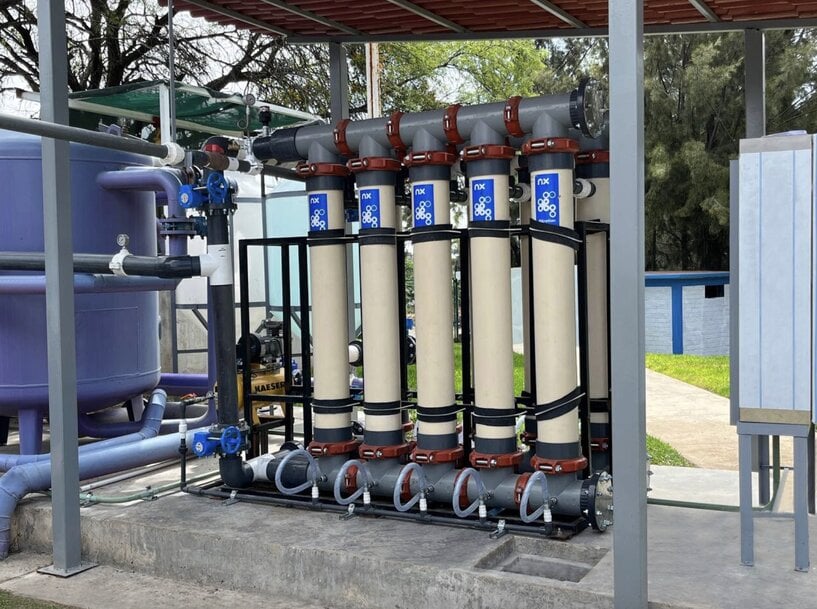
NX Filtration and Haskoning announced a technical partnership to integrate advanced hollow fiber nanofiltration (HFNF) systems into Nereda® Verdygo® Package Plants (NVPP). The collaborative engineering effort addresses the growing international demand for high-purity, decentralized municipal and industrial water treatment installations.
Context of the Cooperation
Global water stress, tightening environmental discharge mandates, and shifting local availability require modular wastewater processing close to the initial point of generation. Traditional centralized public water treatment strategies depend on vast collection pipelines and uniform post-processing configurations, which limit an operator's ability to efficiently deliver customized water qualities tailored to specific regional or industrial reuses.
To solve these scalability challenges, Haskoning and NX Filtration are combining complementary technological portfolios. Royal HaskoningDHV contributes its aerobic granular sludge biological baseline alongside the physical, transportable plant architecture. NX Filtration provides direct membrane filtration modules engineered to remove dissolved organic substances without demanding intensive chemical or energy footprints.
Technical Solution and Responsibilities
The integrated configuration couples biological purification with advanced physical separation.
- Haskoning: Oversees the delivery of the underlying NVPP platform, which applies biological Nereda® aerobic granular sludge technology inside a mobile, containerized layout designed to manage fluctuating smaller-scale influent streams.
- NX Filtration: Supplies its proprietary Hollow Fiber Nanofiltration (HFNF) technology as an integrated post-treatment step within the modular ecosystem.
Operating at a system level, the granular sludge biological stage first achieves efficient organic and nutrient breakdown. The secondary HFNF stage physically blocks a wide range of microscopic fluid components. The joint plant targets the extraction of complex micropollutants—including pharmaceutical residues, color compounds, and selective salts—generating high-quality reuse streams suitable for local agricultural irrigation, specific industrial processes, or environmental drought-relief interventions.
Deployment or Implementation
The modular framework is engineered for direct integration with existing municipal or factory infrastructure. Because the package plants utilize standardized container parameters, they can be deployed rapidly to locations experiencing water scarcity, remote settlements lacking regional pipeline ties, or manufacturing facilities requiring targeted, scalable treatment capacities. The flexible architectural layout allows operators to vary system operation parameters to respond dynamically to changing localized wastewater profiles and specific effluent criteria.
Additional Context
This section details technical specifications and competitive benchmarking not included in the original news release.
Structural Typologies of Nanofiltration Membranes
Nanofiltration implementations in industrial water reuse generally rely on two distinct geometrical formats, which balance fouling tendencies against pure mechanical energy costs:
Deployment or Implementation
The modular framework is engineered for direct integration with existing municipal or factory infrastructure. Because the package plants utilize standardized container parameters, they can be deployed rapidly to locations experiencing water scarcity, remote settlements lacking regional pipeline ties, or manufacturing facilities requiring targeted, scalable treatment capacities. The flexible architectural layout allows operators to vary system operation parameters to respond dynamically to changing localized wastewater profiles and specific effluent criteria.
Additional Context
This section details technical specifications and competitive benchmarking not included in the original news release.
Structural Typologies of Nanofiltration Membranes
Nanofiltration implementations in industrial water reuse generally rely on two distinct geometrical formats, which balance fouling tendencies against pure mechanical energy costs:
- Spiral-Wound Nanofiltration: The historical industry benchmark utilizes flat-sheet polyamide composite membranes wrapped tightly around a central collection pipe. While highly effective at salt rejection, spiral-wound channels feature narrow feed spaces that trap suspended solids. This configuration requires strict, multi-stage upstream pretreatment (such as ultrafiltration and intensive chemical dosing) to prevent premature module clogging.
- Hollow Fiber Nanofiltration (HFNF): The direct filtration method used by NX Filtration uses self-supporting, narrow tubes where the fluid flows directly through the fiber centers. The geometry allows for periodic backwashing with clean water to physically dislodge surface cake layers, removing the requirement for continuous chemical anti-scalant injections and allowing the system to accept higher turbidity feeds directly after standard biological processing.
Competitive Landscape in Decentralized Water Reuse
The global market for advanced municipal and industrial membrane filtration features several prominent product options. FilmTec™ spiral-wound nanofiltration elements are optimized for large-scale industrial softening using thin-film composite polyamide structures. For setups requiring lower fouling liabilities, compact hollow-fiber nanofiltration and ultrafiltration systems utilize hydrophilic polyethersulfone (PES) capillary membranes to maintain high filtration efficiency. In highly specialized or aggressive industrial separation applications, Puramem® selective organic solvent nanofiltration modules offer structural resilience through polyimide-based crosslinked architectures.
Optimizing energy consumption remains a primary focus area across these water treatment technologies. Standard spiral-wound units, like FilmTec™ elements, routinely operate at trans-membrane pressures between 3.0 bar and 10.0 bar, creating significant electrical demands for feed pumps. In contrast, direct hollow-fiber configurations aim to establish operational pressure benchmarks between 1.5 bar and 2.5 bar, providing a lower total energy profile ideal for decentralized, containerized package plants.
Edited by Romila DSilva, Induportals Editor, with AI assistance.
The global market for advanced municipal and industrial membrane filtration features several prominent product options. FilmTec™ spiral-wound nanofiltration elements are optimized for large-scale industrial softening using thin-film composite polyamide structures. For setups requiring lower fouling liabilities, compact hollow-fiber nanofiltration and ultrafiltration systems utilize hydrophilic polyethersulfone (PES) capillary membranes to maintain high filtration efficiency. In highly specialized or aggressive industrial separation applications, Puramem® selective organic solvent nanofiltration modules offer structural resilience through polyimide-based crosslinked architectures.
Optimizing energy consumption remains a primary focus area across these water treatment technologies. Standard spiral-wound units, like FilmTec™ elements, routinely operate at trans-membrane pressures between 3.0 bar and 10.0 bar, creating significant electrical demands for feed pumps. In contrast, direct hollow-fiber configurations aim to establish operational pressure benchmarks between 1.5 bar and 2.5 bar, providing a lower total energy profile ideal for decentralized, containerized package plants.
Edited by Romila DSilva, Induportals Editor, with AI assistance.
