
www.waterplant.tech
08
'26
Written on Modified on
PFAS-Free Liners Strengthen Flow Meter Reliability
Emerson introduces a crosslinked polyethylene design engineered for abrasive slurries and demanding water treatment applications.
www.emerson.com
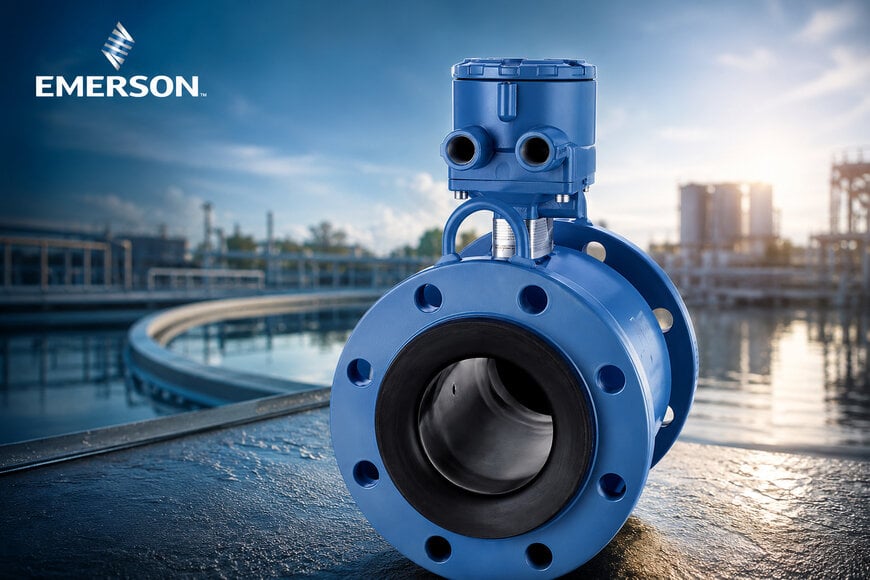
Industrial fluid networks frequently transport abrasive media and aggressive chemical solutions that degrade conventional flow meter insulation layers. The mechanical wear of traditional fluoropolymer-based liners often causes structural flaring, leading to fluid leaks, sensor displacement, and the potential emission of hazardous substances. To address these operational constraints without introducing alternative measurement mechanisms, a new architectural component has been engineered to stabilize long-term fluid monitoring in high-solids applications.
Structural resilience and chemical compatibility in fluid monitoring
The engineering configuration incorporates a crosslinked polyethylene molecular structure into the sensor pathways of industrial flow meters. This crosslinking process modifies the polymer chains to increase mechanical tear resistance and prevent material deformation when exposed to abrasive particulate matter, such as wastewater grit or mining slurries.
The material properties provide a chemically inert barrier that operates without the use of per-and polyfluoroalkyl substances (PFAS). This design facilitates regulatory compliance across municipal water and industrial processing sectors, where environmental restrictions limit fluoropolymer usage. Additionally, the mechanical stability of the crosslinked material reduces the risk of liner flaring during storage or intermittent maintenance sequences, allowing the meters to be uninstalled and reconfigured without compromising the dimensional integrity of the flange interfaces.
Integration specifications and hardware distribution
The crosslinked polyethylene liner option is distributed across multiple sensor configurations to support unified digital supply chain management across heterogeneous automation networks. The technical deployment encompasses three primary hardware platforms:
- Flanged magnetic flow meter sensors optimized for chemical processing loops.
- Dedicated magnetic flow meters configured for municipal water and wastewater transport.
- Modular magnetic flow sensor units designed for highly concentrated slurry lines.
The initial rollout of this technical solution supports pipeline dimensions up to 8 inches in diameter. The system normalizes raw telemetry data at the physical layer, allowing integration into broader industrial automation networks without requiring specific protocol conversion modules or modification of existing programmable logic controller algorithms. This scaling capability enables facilities to maintain uniform diagnostic procedures and predictive maintenance schedules across diverse fluid transport systems.
Additional Context: Technical specifications and competitive benchmarking
This section details technical specifications and competitive benchmarking not included in the original product announcement.
Within the industrial instrumentation market, crosslinked polyethylene (PEX) liners compete directly with established fluoropolymer insulations, such as polytetrafluoroethylene (PTFE) and perfluoroalkoxy alkanes (PFA), which are utilized by manufacturers like Endress+Hauser (Proline Promag series) and Krohne (Optiflux series). Objective material benchmarks indicate that while PFA and PTFE maintain higher maximum thermal thresholds (frequently up to 180°C), PEX provides a superior mechanical abrasion resistance index when measuring fluids containing entrained solids at ambient and mid-range operating temperatures.
Furthermore, conventional PTFE liners require mechanical anchoring or internal mesh reinforcement to withstand vacuum conditions and prevent flaring or delamination under rapid pressure transitions. The rigid crosslinked structure of PEX maintains its geometric stability without internal metallic reinforcement, lowering baseline manufacturing and raw material costs. However, current application parameters restrict PEX deployment to line sizes of 8 inches or smaller, whereas standard fluoropolymer configurations extend up to 24 inches or larger across standard industrial catalogs.
Edited by Sucithra Mani, Induportals editor – adapted by AI.
www.emerson.com
Additional Context: Technical specifications and competitive benchmarking
This section details technical specifications and competitive benchmarking not included in the original product announcement.
Within the industrial instrumentation market, crosslinked polyethylene (PEX) liners compete directly with established fluoropolymer insulations, such as polytetrafluoroethylene (PTFE) and perfluoroalkoxy alkanes (PFA), which are utilized by manufacturers like Endress+Hauser (Proline Promag series) and Krohne (Optiflux series). Objective material benchmarks indicate that while PFA and PTFE maintain higher maximum thermal thresholds (frequently up to 180°C), PEX provides a superior mechanical abrasion resistance index when measuring fluids containing entrained solids at ambient and mid-range operating temperatures.
Furthermore, conventional PTFE liners require mechanical anchoring or internal mesh reinforcement to withstand vacuum conditions and prevent flaring or delamination under rapid pressure transitions. The rigid crosslinked structure of PEX maintains its geometric stability without internal metallic reinforcement, lowering baseline manufacturing and raw material costs. However, current application parameters restrict PEX deployment to line sizes of 8 inches or smaller, whereas standard fluoropolymer configurations extend up to 24 inches or larger across standard industrial catalogs.
Edited by Sucithra Mani, Induportals editor – adapted by AI.
www.emerson.com
