
www.waterplant.tech
31
'26
Written on Modified on
Alfa Laval at WEFTEC 2026
From September 28-30 in New Orleans, Louisiana, Alfa Laval and AquaGreen integrate mechanical dewatering with high-temperature pyrolysis to eliminate municipal sludge contaminants and generate usable biochar.
www.alfalaval.com
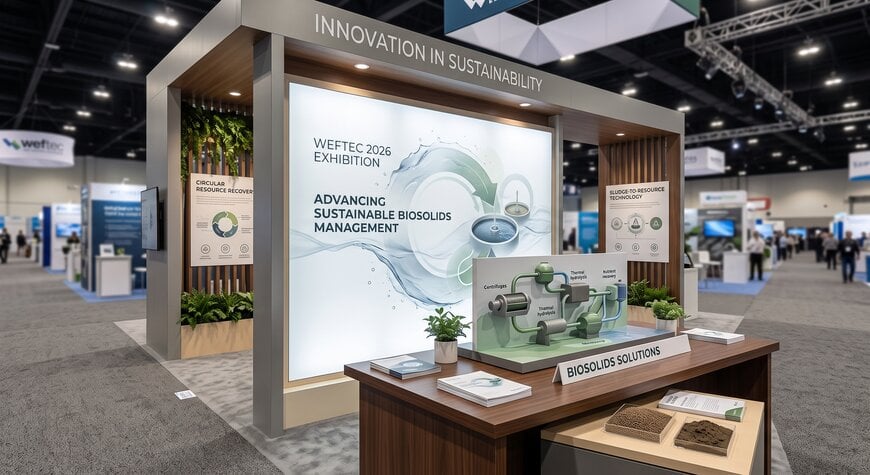
Alfa Laval and AquaGreen collaborate to deploy an integrated sludge handling and resource recovery approach for municipal and industrial wastewater facilities. The combined technical framework links mechanical thickening and dewatering systems directly to high-temperature thermal conversion processes.
Operational Challenges in Sludge Management
Wastewater treatment facilities face increasing regulatory pressure regarding the disposal of dewatered biosolids, particularly concerning persistent organic pollutants such as per- and polyfluoroalkyl substances (PFAS). Conventional disposal routes, such as landfilling or agricultural spreading, risk redistributing stable contaminants into local ecosystems. Addressing this challenge requires an end-to-end processing chain that minimizes sludge volume, neutralizes chemical contaminants, and recovers embedded resources without excessive auxiliary fuel consumption.
Technical Integration and Separation of Functions
The joint technical approach integrates Alfa Laval separation hardware with AquaGreen thermal systems:
- Alfa Laval provides upstream mechanical solid-liquid separation, utilizing equipment such as sequencing batch reactors, Iso-Disc cloth media filters, and Ashbrook Simon-Hartley dewatering systems to optimize solid cake concentration.
- AquaGreen provides the downstream Integrated Drying & Pyrolysis (IDP) system, which subjects the dewatered biosolids to high-temperature thermal treatment in an oxygen-depleted environment.
Combining high-efficiency mechanical dewatering with the IDP system ensures that biosolids enter the drying and pyrolysis phases at optimal moisture levels. This thermal sequence breaks down organic contaminants, including PFAS, while converting residual mass into stable biochar, capturing retained phosphorus, and generating reusable thermal energy to sustain the continuous operation.
Implementation and Technical Review
The companies present their integrated process architecture at WEFTEC 2026, held September 28–30 in New Orleans, Louisiana (booth #1829). Technical discussions focus on retrofit configurations for existing industrial and municipal infrastructure, mass-balance efficiency, and emissions compliance for facilities upgrading from standard waste disposal to circular resource management.
System Impact
The combined process reduces overall biosolids transport volume, eliminates the dispersion of persistent contaminants, and converts a municipal waste stream into solid-phase biochar suitable for industrial and agricultural reuse.
Edited by Evgeny Churilov, Induportals Media - Adapted by AI.
www.alfalaval.com
Implementation and Technical Review
The companies present their integrated process architecture at WEFTEC 2026, held September 28–30 in New Orleans, Louisiana (booth #1829). Technical discussions focus on retrofit configurations for existing industrial and municipal infrastructure, mass-balance efficiency, and emissions compliance for facilities upgrading from standard waste disposal to circular resource management.
System Impact
The combined process reduces overall biosolids transport volume, eliminates the dispersion of persistent contaminants, and converts a municipal waste stream into solid-phase biochar suitable for industrial and agricultural reuse.
Edited by Evgeny Churilov, Induportals Media - Adapted by AI.
www.alfalaval.com
