
www.waterplant.tech
24
'26
Written on Modified on
ABB Outlines Water Infrastructure Efficiency at WodKan Tech 2026
Electrification and digital drive technologies mitigate rising industrial power expenses through automated process regulation and targeted pump modernization programs.
global.abb
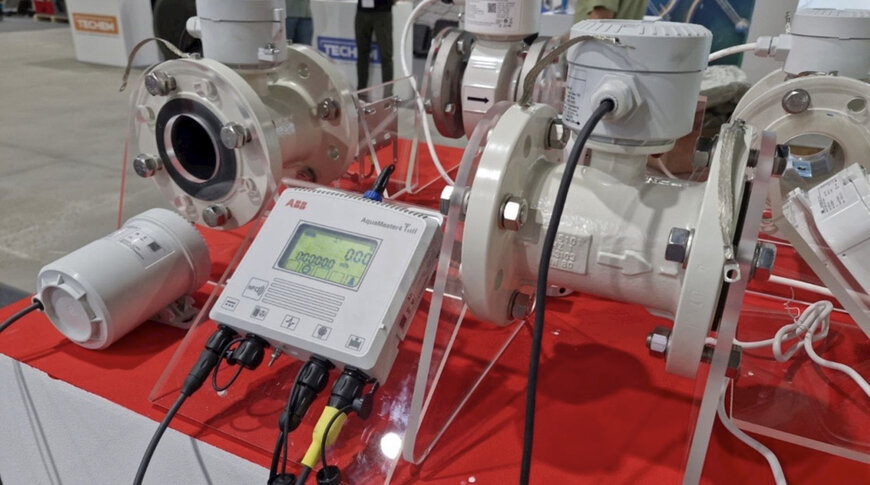
ABB presented its energy-efficiency and drive-system strategies for the municipal water and wastewater sector at the WodKan Tech 2026 exhibition in Warsaw, Poland. The company outlined technical approaches to reduce operating expenditures and power consumption through variable-speed drive integrations, motor upgrades, and automated supervisory monitoring across municipal utility networks.
Industrial Energy Exposure and Municipal Utility Loads
Fluctuating electricity tariffs represent a critical financial factor for industrial processing and municipal services. In the ABB Trends 2026/2027 study, 68 percent of surveyed industrial enterprises identified escalating power prices as a primary risk to operational profitability, while 23 percent indicated that utility overhead directly compresses profit margins. In response, 38 percent of operators have deployed automated energy management architectures and continuous telemetry to monitor facility power usage profiles.
Pumping systems constitute the largest share of continuous electrical load across water treatment and distribution networks, driving raw intake, network pressurization, and sludge dewatering. The combined electrical load of water supply stations and wastewater treatment facilities serving Warsaw is comparable to the annual energy demand of approximately 80,000 households.
Drive Retrofitting and Systemic Efficiency Gains
Efficiency audits conducted across wastewater installations frequently document aging pumping assets operating at mechanical efficiencies below 50 to 60 percent. Retrofitting these installations with modern components reduces cumulative power consumption by up to 30 percent. Implementing variable frequency drives (VFD) to continuously regulate motor rotational speeds according to diurnal flow shifts yields direct efficiency increases between 10 and 50 percent. This dynamic regulation adjusts hydraulic output to match real-time system demand, avoiding structural civil engineering modifications while eliminating reliance on mechanical throttling valves.
Beyond main distribution pumps, treatment facilities utilize auxiliary aerators, blowers, mechanical mixers, and filter presses. Replacing legacy low-efficiency drives with high-efficiency motor classes delivers an incremental power consumption reduction of 1.5 to 3.0 percent across continuous operation cycles.
Tadeusz Barański, representative of ABB Drive Systems in Poland, stated that industrial pumps operating below standard efficiency thresholds achieve energy draw reductions near 30 percent when retrofitted, while automated motor speed modulation provides immediate operational efficiency gains without requiring structural facility reconstruction.
Bartosz Stasiak, water and wastewater sector specialist at ABB, noted that utility operators must reconcile complex regulatory mandates, network resilience standards, and energy constraints by prioritizing automated assets that streamline continuous facility management.
Multidisciplinary Investments and Network Modernization
The technical discussions at WodKan Tech 2026 covered physical water loss mitigation through precision district metering, localized biogas cogeneration, distributed solar arrays, and operational cybersecurity. Capital allocation is supported through national and European funding mechanisms, including the Cyber-Safe Water Network initiative, the National Recovery and Resilience Plan (KPO), the Swiss-Polish Cooperation Programme, and the European Funds for Infrastructure, Climate, Environment (FEnIKS). These financing avenues permit utility operators to transition deferred maintenance programs into active industrial automation projects.
Additional Context:
This section details technical specifications and competitive benchmarking not included in the original product announcement
Municipal pumping stations and wastewater treatment installations rely on International Efficiency standards (IEC 60034-30-1) to evaluate motor-driven machinery. While legacy utilities predominantly run on IE2 (High Efficiency) or IE3 (Premium Efficiency) squirrel-cage induction motors, current modernizations focus on IE4 (Super Premium) and IE5 (Ultra-Premium) efficiency tiers, notably utilizing synchronous reluctance motor (SynRM) technology to eliminate rotor heating losses.
Within the municipal water and wastewater drives sector, ABB competes directly with industrial automation suppliers including Danfoss, Siemens, and Schneider Electric:
ABB delivers dedicated water industry drives via the ACQ580 series, featuring specialized application control firmware for pump cleaning, pipe fill management, and multi-pump cascade operations across low-voltage ranges up to 500 kW. When paired with ABB IE5 SynRM packages, the powertrain reduces internal electrical losses by up to 40 percent compared to conventional IE3 induction packages.
Danfoss addresses the utility market with the VLT Aqua Drive FC 202, engineered to regulate variable torque centrifugal pumps, positive displacement blowers, and aerators. Danfoss emphasizes advanced cascade control algorithms, deragging sequences, and back-channel cooling architectures to manage thermal dissipation inside compact electrical enclosures.
Siemens provides water sector motion control through the Sinamics G120X and Sinamics G120P portfolios, supporting motor control across power ranges up to 640 kW. Siemens natively integrates pump protection metrics, multi-pump staging, and continuous connectivity to the MindSphere industrial Internet of Things architecture via Profinet or Ethernet/IP communication backbones.
Schneider Electric competes through the Altivar Process ATV600 family, integrating embedded power measurement meters with real-time operational pump curve monitoring, predicting mechanical deviation and cavitation risks without secondary external sensors.
In direct technical comparison, motor and drive combinations across this segment benchmark on harmonic distortion mitigation, functional safety certifications, and wire-to-water efficiency. Leading configurations maintain total harmonic distortion (THDi) below 3 percent at rated load using active front end (AFE) or passive harmonic filter designs, preserving electrical grid stability across municipal substations.
Edited by Natania Lyngdoh, Induportals editor, assisted by AI.
www.abb.com
