
www.waterplant.tech
26
'25
Written on Modified on
LG Sonic Enables Real-Time Water Quality Monitoring for Lakes
A buoy-based monitoring system provides continuous, multi-parameter water quality data for lakes and reservoirs, helping operators detect risks early and manage drinking-water sources more effectively.
www.lgsonic.com

Continuous insight into lake and reservoir conditions is increasingly critical for drinking-water utilities and surface water operators seeking to detect risks before they affect treatment or compliance. Toward this need, LG Sonic has introduced a buoy-based real-time water quality monitoring system designed for lakes and reservoirs.
From episodic sampling to continuous visibility
Operating lakes and drinking-water reservoirs has traditionally relied on grab sampling and periodic laboratory analysis. While these methods provide accurate point measurements, they capture only isolated moments in time and can miss short-lived but operationally significant events, such as nighttime oxygen depletion, sudden turbidity increases after rainfall, or early-stage algal growth near abstraction points.
Real-time water quality monitoring systems address this limitation by converting discrete measurements into a continuous data stream. In lake and reservoir environments—where stratification, wind-driven mixing, inflows, and biological processes can shift conditions within hours—continuous monitoring provides a more representative operational picture than periodic sampling alone.

How buoy-based monitoring systems are deployed
A typical real-time monitoring setup combines in-situ sensors, data logging and telemetry hardware, an autonomous power supply, and cloud-based software for data processing and visualisation. In surface waters, these systems are installed either as fixed nearshore stations or as floating platforms in deeper or less accessible areas.
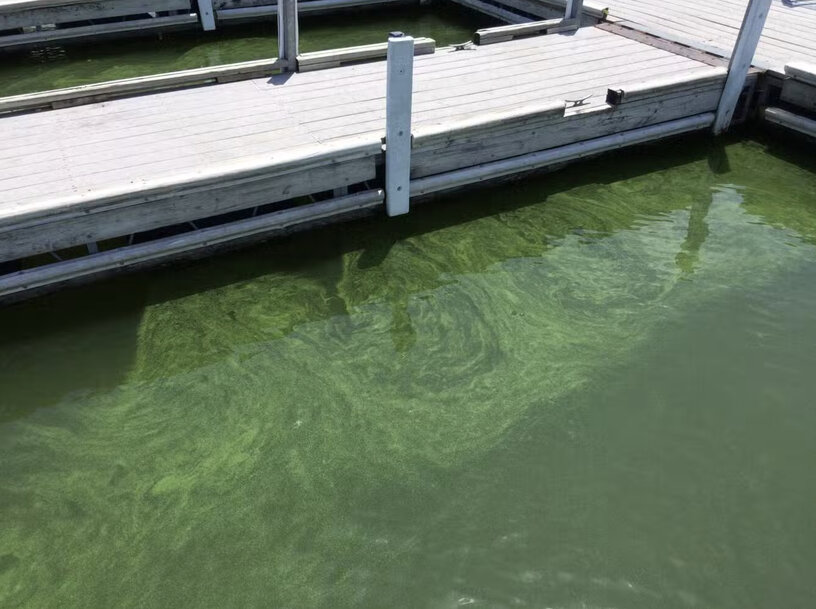
Unlike handheld instruments used for spot checks, permanently deployed buoy systems remain in the water continuously. This allows them to capture short-term dynamics that are otherwise difficult to observe, including transient surface algal accumulations or rapid changes in dissolved oxygen associated with stratification breakdown.
Core parameters and data transmission
Modern lake and reservoir monitoring equipment commonly measures a set of core water quality parameters that together indicate ecosystem health and treatment risk. These include temperature, dissolved oxygen, pH, conductivity, turbidity, and algal indicators such as chlorophyll-a and phycocyanin. Measurements are transmitted via cellular, radio, or satellite communication links to cloud platforms, where dashboards support trend analysis, alerting, reporting, and long-term data storage.
By analysing these parameters together, operators can detect gradual trends—such as increasing surface temperatures or rising chlorophyll-a concentrations—as well as abrupt events like turbidity spikes following heavy rainfall.

Multi-depth insight across the water column
LG Sonic’s Monitoring-Buoy is designed as an integrated floating platform equipped with multiple sensors positioned at different depths. This configuration allows operators to observe vertical gradients in temperature, oxygen, and algal activity, rather than relying solely on surface measurements.
The system uses solar-powered electronics to support year-round operation with limited maintenance visits, including at remote reservoir sites. Monitoring conditions at multiple depths is particularly relevant in stratified lakes, where low-oxygen zones or elevated algal concentrations may develop below the surface and affect intake water quality.
Operational use in drinking-water and industrial reservoirs
When deployed as part of an online water quality monitoring system, the Monitoring-Buoy supports near real-time tracking of algal development, oxygen distribution, and turbidity. For drinking-water utilities, this data can inform operational decisions such as adjusting abstraction depths, modifying treatment processes, or preparing mitigation measures before water quality changes escalate into regulatory non-compliance or customer complaints.
Beyond immediate operational control, continuous monitoring also builds a long-term data record of reservoir behaviour. Over time, operators can identify recurring seasonal patterns, assess how rapidly water quality responds to interventions, and document performance trends for regulators and stakeholders. When combined with complementary inputs such as satellite observations and weather forecasts, these datasets can strengthen early-warning capabilities in bloom-prone water bodies.
A growing role in the digital water monitoring landscape
As regulatory expectations and public scrutiny around drinking-water protection increase, real-time water quality monitoring is becoming a foundational element of lake and reservoir management. By replacing episodic sampling with continuous, multi-parameter insight, buoy-based systems contribute to more informed decision-making, improved operational resilience, and stronger protection of freshwater resources within the broader digital water monitoring ecosystem.
www.lgsonic.com
