
www.waterplant.tech
16
'26
Written on Modified on
Low NPSH impellers improve pump suction performance
National Pump Company develops modular impeller configurations to optimise hydraulic efficiency and reduce cavitation in vertical turbine pump systems.
www.nationalpumpcompany.com
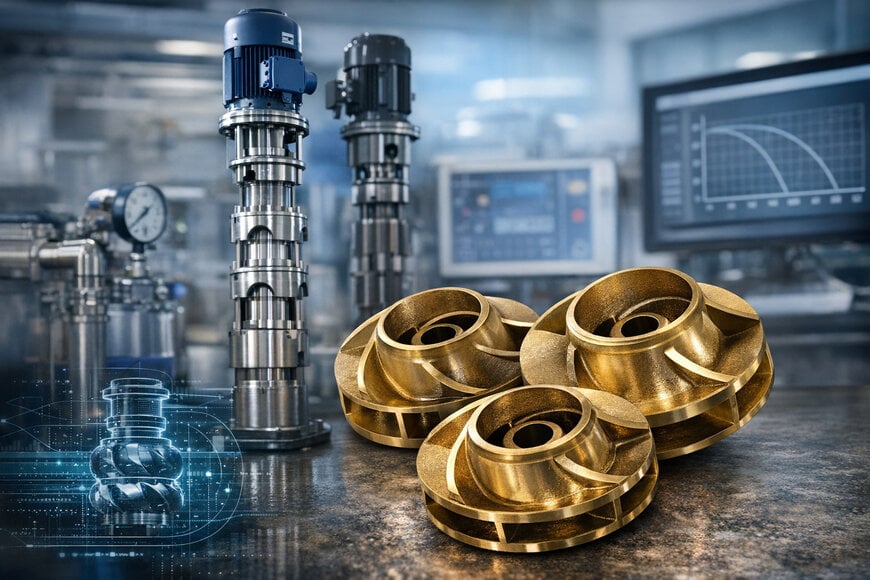
Low Net Positive Suction Head Required (NPSHR) impellers are being introduced to address suction limitations in vertical turbine pumps, enabling more reliable operation and improved hydraulic matching across industrial and municipal applications.
Addressing suction limitations in pump systems
Net Positive Suction Head Required (NPSHR) is a key parameter in pump design, directly influencing the risk of cavitation, efficiency losses, and component wear. In vertical turbine pumps, NPSHR is determined at the first stage, making this component critical for overall system stability.
National Pump Company has developed a series of low NPSH first-stage impellers specifically engineered to reduce NPSHR while maintaining hydraulic performance. These components are designed for installations where available suction head (NPSHA) is constrained or subject to variation, such as water supply systems, industrial processing, and energy infrastructure.
Modular hydraulic configuration for flexibility
The product line includes 12 first-stage impeller options in 2-inch size increments, enabling precise hydraulic matching to system requirements. A key design feature is the ability to combine low NPSH first-stage impellers with different impeller geometries in subsequent stages within the bowl assembly.
This modular configuration allows engineers to optimise flow rate, head, and efficiency simultaneously while ensuring compliance with NPSHA constraints. For example, specific first-stage impellers can be paired with multiple downstream stage designs to tailor performance envelopes without redesigning the entire pump system.
Such flexibility supports integration into a broader digital supply chain, where component standardisation and configurable assemblies enable faster engineering workflows and reduced lead times.
Reducing cavitation risk without structural modifications
In suction-limited environments, traditional approaches to increasing NPSHA include lowering pump installation depth or deploying alternative pump types such as canned systems. Each additional foot of installation depth typically increases available NPSH by approximately one foot, but also raises capital and installation costs.
Low NPSH impellers provide an engineered alternative by reducing the required suction head at the inlet. This approach mitigates cavitation risk without requiring structural modifications to the installation, supporting cost optimisation over the equipment lifecycle.
Expanding hydraulic coverage
Additional low NPSH impeller models are under development for release in 2026 and 2027. These designs are intended to extend compatibility across a wider range of flow and head conditions, enabling application in more complex or variable operating environments.
By increasing the available combinations of first-stage and downstream impellers, the system supports broader hydraulic coverage and enhances adaptability to evolving operational requirements.
Application across industrial and municipal sectors
The technology is applicable across sectors where vertical turbine pumps are used under constrained suction conditions, including municipal water systems, industrial processing, and API-related applications. In these contexts, maintaining stable inlet conditions is essential to ensure long-term reliability and efficiency.
The development of low NPSH impellers reflects a shift toward component-level optimisation in pump engineering, where targeted design improvements at critical stages can deliver measurable gains in performance, reliability, and lifecycle cost control.
Edited by an industrial journalist Sucithra Mani with AI assistance.
www.nationalpumpcompany.com
