
www.waterplant.tech
17
'26
Written on Modified on
Wireless Monitoring Cuts Costs for River Flow Measurement
NIVUS uses satellite-synchronised timing and solar power to replace cross-river cabling at England’s River Ouse.
www.nivus.com
Application areas: River flow monitoring, hydrometry, water infrastructure management
Industry sectors: Water management, environmental monitoring, public utilities
The Environment Agency (EA) in England uses river flow measurements for flood warning, hydrological modelling, forecasting, water infrastructure management and abstraction licensing. Its monitoring network comprises around 7,000 hydrometric stations across England, providing high-resolution measurements of river flow, river level, groundwater and rainfall.
At Barcombe Mills in East Sussex, the EA needed to replace a failed Transit Time flow monitoring system that had been operating at the River Ouse site for many years. The replacement had to maintain continuous and accurate flow measurement while avoiding the substantial civil works and environmental impacts associated with replacing the existing cross-river duct.
Limitations of conventional Transit Time monitoring
The Transit Time method determines river velocity by measuring the difference in transmission time of acoustic signals travelling downstream and upstream. Sensors positioned on opposite riverbanks provide a full velocity profile and continuous discharge measurements.
The technique has been used by the EA for decades, but its very high timing accuracy traditionally required the sensors on both banks to be connected by cross-river cabling. At Barcombe Mills, the previous installation used a duct positioned on the riverbed and weighted with clay chimney pots.
Replacing the duct would have required significant installation work and raised environmental concerns. An alternative involving a tunnel beneath the river was also considered impractical because of the cost and the proximity of the reservoir.
Wireless synchronisation replaces cross-river cabling
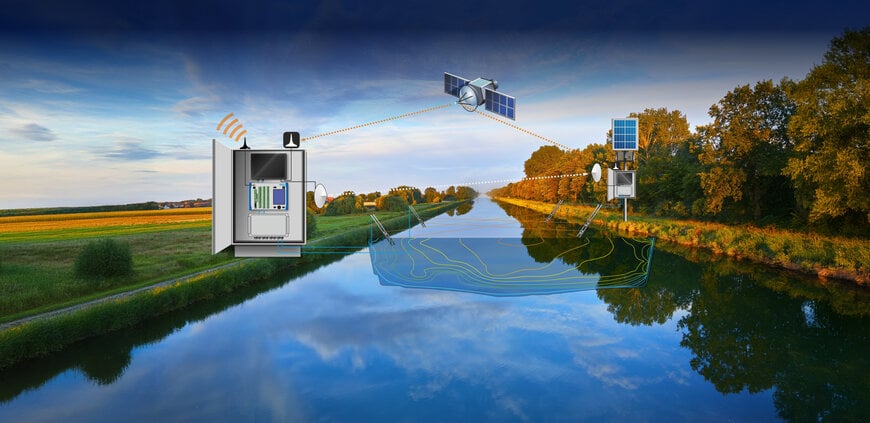
NIVUS supplied its Wireless Transit Time (WTT) system for the replacement installation. The system retains the acoustic Transit Time measurement principle while using wireless communication between the sensors.
The timing of the transmitter/receivers is synchronised using GPS satellites with atomic clocks. This provides the precise timing required to calculate upstream and downstream signal transmission differences without relying on a physical cable across the river.
The approach also reduces the need for invasive construction. Bankside equipment can be anchored using ground screws rather than concrete foundations, while the system can operate from solar power. This allows the monitoring installation to operate off-grid and simplifies decommissioning.
Existing sensors reduce replacement requirements
The River Ouse at Barcombe Mills is approximately 20 metres wide. The previous installation incorporated two sets of sensors mounted in submerged racks on opposite banks, with eight signal paths.
The existing sensors could be reused with the new WTT system. This reduced the amount of new equipment required and contributed to lower installation costs.
According to the EA, the estimated cost of the wireless system was approximately 25% of the cost of a ducted Transit Time installation. The wireless approach therefore provided a replacement for the failed monitoring system without the expense and environmental implications associated with new cross-river ducting.
Solar-powered monitoring at Barcombe Mills
The Barcombe Mills installation is the first fully solar-powered WTT system deployed by the EA. Two other NIVUS WTT installations operated by the agency, in North London and Yorkshire, use mains power.
The use of solar power removes the requirement for a mains electrical connection at the site. Combined with wireless communication and ground-screw installation, this provides an off-grid monitoring configuration with fewer permanent works.
Supporting future river monitoring upgrades
The Barcombe Mills deployment forms part of the EA's wider evaluation of wireless Transit Time monitoring. The agency is considering replacing existing cabled Transit Time systems with wireless versions as the installations reach the end of their service life.
The application demonstrates how satellite-synchronised timing can address one of the main installation constraints associated with conventional Transit Time flow monitoring. For monitoring sites where cross-river ducting is expensive, technically difficult or environmentally undesirable, the wireless configuration provides an alternative while retaining continuous acoustic flow measurement.
Edited by Sucithra Mani, Induportals editor – adapted by AI.
www.nivus.com
