
www.waterplant.tech
20
'26
Written on Modified on
Wastewater Pumps Target Efficiency and Clogging Risks
KSB combines optimized hydraulics, efficient motors and condition monitoring to improve reliability across demanding pumping applications.
www.ksb.com
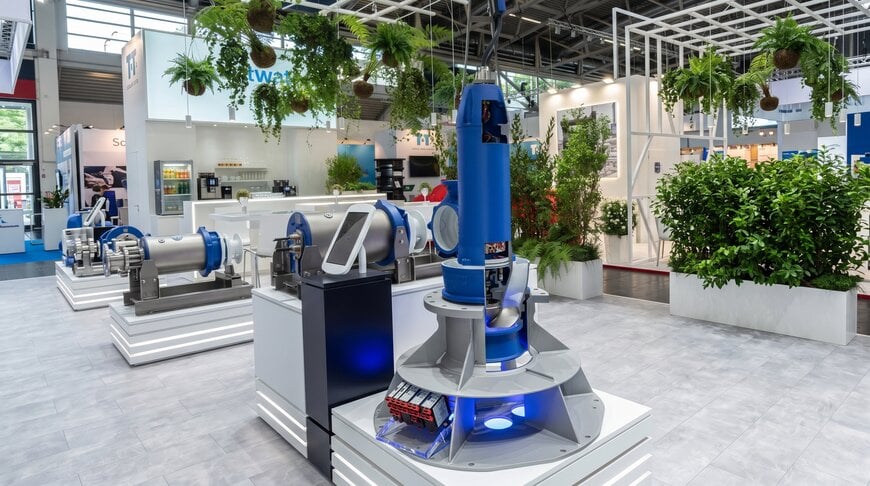
Submersible pumps in discharge tubes represent a standard configuration for moving large fluid volumes at low-to-medium heads across municipal wastewater transport, stormwater handling, agricultural irrigation, and industrial drainage. The third expansion level of the AmaCan P and AmaCan D series incorporates revised hydraulic geometries and fluid dynamics modeling to address clogging risks, energy consumption, and structural intake constraints in wet-well pumping stations.
Hydraulic Optimization and Clogging Resistance
Operating reliability in untreated wastewater relies heavily on free passage dimensions and impeller geometry. The updated design integrates wide internal clearances alongside self-cleaning blade profiles to mitigate clogging caused by stringy solids and fibrous matter. Fluid handling flexibility is achieved through adjustable blade angles in the propeller-type AmaCan P units and trimmed impeller diameters in the mixed-flow AmaCan D units. These mechanisms permit precise calibration to target duty points, matching flow velocity to system resistance curves while preventing cavitation and mechanical overloads.
Drive Efficiency and Integrated Condition Monitoring
To limit operational expenditure during continuous duty, drive systems are configured with premium and super-premium efficiency class electric motors. Dynamic performance is tracked through an integrated sensor array measuring vibration amplitudes, mechanical seal leakage, bearing operating temperatures, and motor winding thermal thresholds. When linked to digital condition monitoring interfaces, these sensors identify deviations in real time, shifting maintenance operations from reactive repairs to predictive service schedules.
Intake Flow Conditioning and Civil Engineering Integration
Intake turbulence and rotational swirl often compromise pump performance in compact sumps, historically requiring complex baffle walls. The AmaStraight installation module serves as an integrated flow straightener positioned at the pump inlet to stabilize approach velocity profiles and suppress pre-rotation. Mechanically, the unit routes hydrodynamic operating thrust and piping loads directly into the concrete base slab. This design eliminates internal separation walls, enables dense side-by-side positioning of multiple units, and reduces the excavation footprint required for stormwater and flood control installations.
Additional Context
This section details technical specifications and competitive benchmarking not included in the original product announcement.
Tubular casing submersible pumps compete directly with lines such as the Flygt PL/LL series from Xylem and the Grundfos KPL/KWM range. Standard engineering benchmarks in this category focus on hydraulic efficiency, motor efficiency classifications (IE3 and IE4 equivalents under IEC 60034-30-1), free spherical passage clearance, and civil footprint requirements.
While competitive designs often require deep sumps with specialized structural divider walls to prevent surface vortex formation and uneven inflow distribution, direct-inlet flow conditioning units like the AmaStraight reduce minimum required submergence depth and pitch distances between parallel pump columns. In applications demanding high solids handling, the integration of adjustable axial propeller blades provides wider operational flexibility per nominal diameter compared to fixed-vane axial configurations, matching peak hydraulic efficiency across fluctuating seasonal head profiles.
Edited by Evgeny Churilov, Induportals Media - Adapted by AI.
www.ksb.com
