
www.waterplant.tech
25
'26
Written on Modified on
Decentralized Water Systems Strengthen Infrastructure Resilience
Lutz-Jesco deploys containerized treatment and on-site disinfection systems to support water supplies during infrastructure disruptions.
www.lutz-pumpen.de
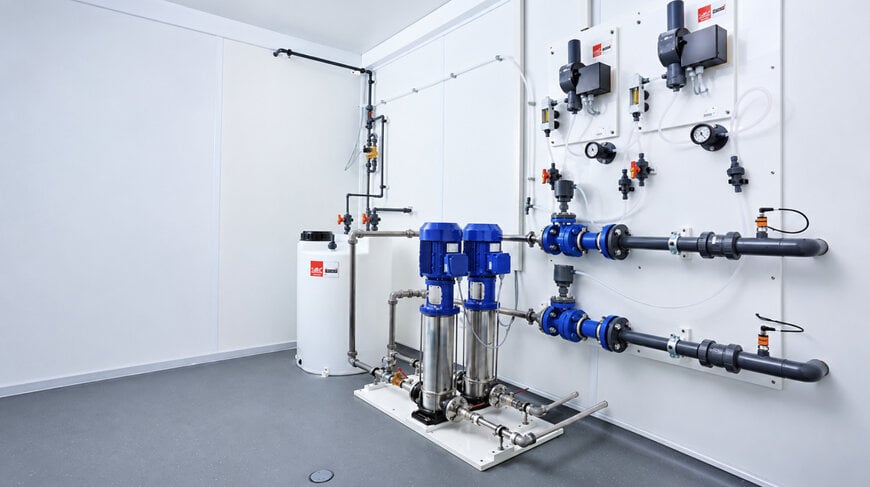
The vulnerability of municipal water networks requires robust engineering strategies that replace centralized points of failure with modular, distributed architecture. Lutz-Jesco presents technical solutions for decentralized water supply at the ReBuild Ukraine 2026 trade show, held on November 12 and 13, 2026, in Warsaw, Poland (booth 1-B6). The initiative addresses operational continuity challenges for municipal water utilities facing infrastructure disruptions.
Technical Solution and Division of Responsibilities
The decentralized model supplements conventional waterworks with independent, distributed supply units. Lutz-Jesco engineers, pre-assembles, and tests water treatment and disinfection technology inside transportable containers prior to site delivery. Participating municipal utilities provide raw water sources, local piping connections, and primary power supplies, while Lutz-Jesco supplies the treatment infrastructure, electrolysis modules, and mobile chlorination units.
The technical architecture relies on modular filtration and chemical dosing systems integrated within standard shipping containers. Water treatment processes incorporate multi-stage filtration paired with on-demand disinfection. Electrolysis equipment generates sodium hypochlorite directly on-site using standard sodium chloride and water, eliminating the logistical constraints of transporting hazardous chlorine gas or liquid chemicals. For localized requirements, the company utilizes plug-and-play mobile chlorination systems mounted on handcarts for rapid manual deployment.
Implementation and Integration
Deployment builds upon previous implementation methodologies established through international projects involving the Deutsche Gesellschaft für Internationale Zusammenarbeit. Three containerized mobile waterworks previously supplied to Ukraine achieved an aggregate treatment capacity of 300 cubic meters per hour, supporting approximately 300,000 individuals. Integration involves positioning containerized units on reinforced concrete pads, establishing hydraulic connections to local boreholes or surface water intakes, and connecting low-voltage power supplies. System validation includes pressure testing, microbiological water quality sampling, and flow calibration.
Applications and Operational Impact
Target application areas encompass municipal water networks, emergency relief sectors, and decentralized rural communities requiring autonomous operation. Concrete use cases include emergency drinking water production following infrastructure damage and supplemental water augmentation for isolated municipal zones. Operational benefits include elimination of chemical supply chain dependencies via on-site oxidant generation, rapid deployment timelines, and redundancy that prevents total system collapse during localized grid or structural failures.
Edited by Sucithra Mani, Induportals editor – adapted by AI.
www.lutz-jesco.com
