
www.waterplant.tech
24
'26
Written on Modified on
Underwater Adhesive Supports Coral Reef Restoration
Marine conservation teams selected Pratley to secure coral fragments in harsh marine environments, enabling durable reef restoration without ecological harm.
www.pratley.com
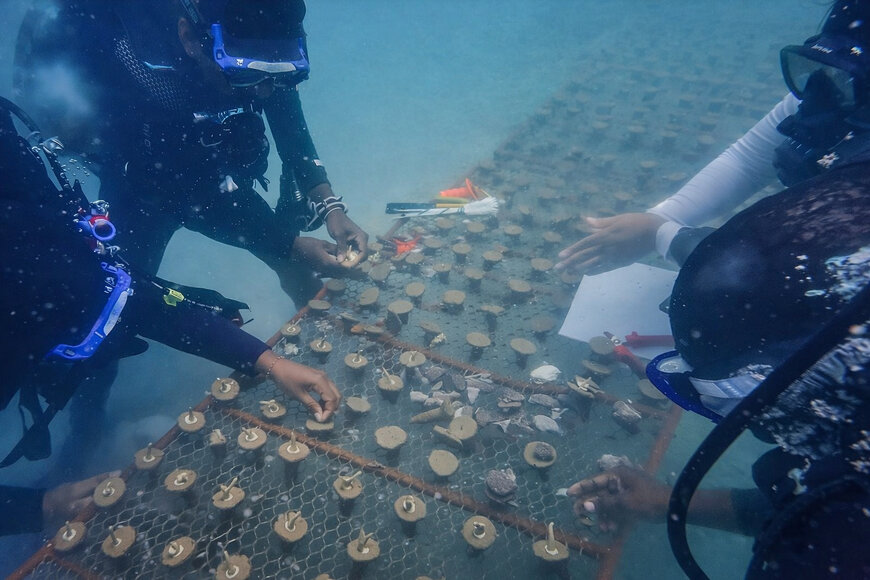
Marine conservation organisations working in reef restoration operate in highly demanding underwater environments. Their core activity involves stabilising coral fragments and repairing damaged ecosystems in areas exposed to strong currents, salinity, temperature fluctuations and biological sensitivity.
Traditional fastening and bonding methods have often proven unsuitable underwater. Many conventional adhesives fail to cure properly in submerged conditions, degrade under continuous saltwater exposure or risk releasing substances harmful to marine ecosystems.
Conservation teams therefore required a bonding solution that could:
- Cure effectively underwater
- Resist long-term corrosion in saltwater
- Remain chemically stable after curing
- Avoid environmental contamination
- Provide mechanical strength in turbulent conditions
The goal was to improve restoration efficiency while minimising ecological disturbance and long-term maintenance requirements.
Selection of an Industrial Adhesive
To address these constraints, conservationists adopted Pratley Standard Setting Putty, originally developed for industrial applications.
The product was selected primarily for its ability to be mixed manually and applied directly underwater. Once cured, the material becomes chemically inert, preventing the release of harmful substances into sensitive reef ecosystems.
According to Mark Bell, National Sales and Marketing Manager at Pratley, conservationists identified that the putty could secure coral fragments to reef structures without compromising marine life. The material’s industrial-grade durability, combined with its chemical stability, met both structural and environmental requirements.
Deployment in Underwater Conditions
In practice, divers prepare the two-component putty on the surface, place it in sealed plastic bags and transport it to the reef site. Underwater, the material is applied directly to anchor coral fragments to stable substrates.
This method simplifies logistics in submerged environments and eliminates the need for mechanical fasteners or complex installation equipment. The curing process occurs in situ, enabling effective bonding even in areas exposed to moderate water movement.
The straightforward handling procedure reduced operational complexity during dives and enabled more controlled placement of coral fragments compared with traditional techniques.
Operational and Environmental Benefits
Although no quantified performance figures were disclosed, technical evaluation indicates several measurable operational advantages:
Selection of an Industrial Adhesive
To address these constraints, conservationists adopted Pratley Standard Setting Putty, originally developed for industrial applications.
The product was selected primarily for its ability to be mixed manually and applied directly underwater. Once cured, the material becomes chemically inert, preventing the release of harmful substances into sensitive reef ecosystems.
According to Mark Bell, National Sales and Marketing Manager at Pratley, conservationists identified that the putty could secure coral fragments to reef structures without compromising marine life. The material’s industrial-grade durability, combined with its chemical stability, met both structural and environmental requirements.
Deployment in Underwater Conditions
In practice, divers prepare the two-component putty on the surface, place it in sealed plastic bags and transport it to the reef site. Underwater, the material is applied directly to anchor coral fragments to stable substrates.
This method simplifies logistics in submerged environments and eliminates the need for mechanical fasteners or complex installation equipment. The curing process occurs in situ, enabling effective bonding even in areas exposed to moderate water movement.
The straightforward handling procedure reduced operational complexity during dives and enabled more controlled placement of coral fragments compared with traditional techniques.
Operational and Environmental Benefits
Although no quantified performance figures were disclosed, technical evaluation indicates several measurable operational advantages:
- Increased bonding reliability in submerged environments
- Reduced need for repeated reattachment interventions
- Improved stability of transplanted coral fragments
- Elimination of chemical contamination risks
- Lower mechanical disturbance compared to drilling or anchoring
The inert nature of the cured material supports long-term ecosystem stability. By enabling “repair over replacement,” conservation teams can restore damaged reef sections with minimal structural disruption.
Broader Wildlife Protection Applications
The same industrial adhesive technology has also been deployed in wildlife conservation projects beyond reef restoration. Applications include emergency repair of damaged sea turtle shells and the attachment of radio transmitters to pangolins and rhinos for monitoring purposes.
These use cases demonstrate how industrial materials can be repurposed for environmental protection when their chemical properties and mechanical characteristics align with ecological requirements.
Industry Conservation Collaboration
The case illustrates how industrial innovation can support marine conservation through adaptive application of existing technologies. Rather than developing entirely new materials, conservation professionals evaluated industrial underwater adhesives against ecological criteria and operational demands.
This cross-sector collaboration enables technically robust, field-ready solutions that meet both mechanical and environmental standards. As marine restoration projects expand globally, the integration of industrial materials into conservation practice is likely to play an increasing role in delivering durable protection outcomes.
www.pratley.com
Broader Wildlife Protection Applications
The same industrial adhesive technology has also been deployed in wildlife conservation projects beyond reef restoration. Applications include emergency repair of damaged sea turtle shells and the attachment of radio transmitters to pangolins and rhinos for monitoring purposes.
These use cases demonstrate how industrial materials can be repurposed for environmental protection when their chemical properties and mechanical characteristics align with ecological requirements.
Industry Conservation Collaboration
The case illustrates how industrial innovation can support marine conservation through adaptive application of existing technologies. Rather than developing entirely new materials, conservation professionals evaluated industrial underwater adhesives against ecological criteria and operational demands.
This cross-sector collaboration enables technically robust, field-ready solutions that meet both mechanical and environmental standards. As marine restoration projects expand globally, the integration of industrial materials into conservation practice is likely to play an increasing role in delivering durable protection outcomes.
www.pratley.com
