
www.waterplant.tech
22
'26
Written on Modified on
Preventing biofouling in ultrasonic reservoir systems
LG Sonic develops mechanical cleaning technology to maintain acoustic performance in algae control systems across water treatment applications.
www.lgsonic.com
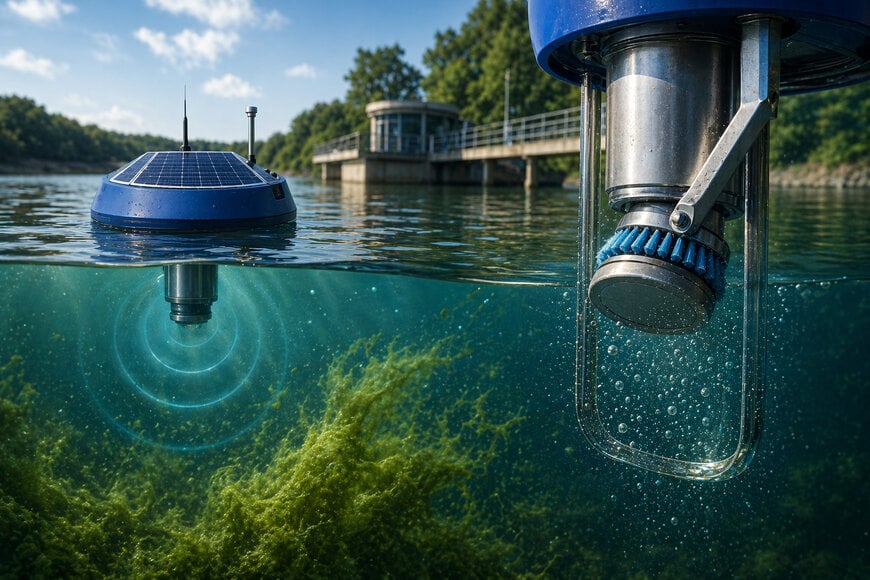
Ultrasonic algae control systems in reservoirs often experience performance decline due to biofouling on transducer surfaces, which blocks acoustic energy transmission despite normal system operation. Mechanical cleaning technologies aim to maintain consistent treatment efficiency in drinking water, irrigation, and industrial reservoir applications.
Biofouling as a primary failure mechanism
In reservoir-based ultrasonic treatment systems, performance degradation is rarely caused by electronic failure. Instead, biological accumulation on the transducer surface known as biofouling gradually prevents acoustic energy from entering the water column.
Biofouling begins immediately after deployment. Proteins form a conditioning layer within minutes, followed by bacterial adhesion and secretion of extracellular polymeric substances (EPS) within hours. Within approximately 48 hours, adhesion becomes irreversible, and within days, microalgae colonize the surface. In hard-water environments, calcium carbonate scaling forms on top of the biofilm within weeks.
This layered buildup alters the acoustic interface, leading to reflection, absorption, and scattering of ultrasonic waves. As a result, treatment effectiveness can decline significantly within the first week and may become negligible after several weeks, even though the system continues to report operational status.
Impact on acoustic performance and treatment efficiency
The presence of biofilm and mineral scale affects ultrasonic transducers through multiple mechanisms. The altered surface impedance causes partial reflection of acoustic energy back into the housing, reducing transmission into the water. Added mass shifts the resonant frequency of the transducer, leading to off-design operation and reduced efficiency.
Non-uniform fouling introduces beam scattering, limiting the ability to target algae at depth, while the viscoelastic properties of biofilms absorb energy and convert it into heat rather than propagating it through the water.
In operational terms, these effects result in reduced algae suppression, increased reliance on downstream treatment processes such as activated carbon dosing, and higher overall treatment costs.
Operational indicators of performance decline
Biofouling is typically not detected through system diagnostics, as power consumption and status indicators remain unchanged. Instead, performance degradation becomes visible through indirect indicators.
Reservoir-level signs include the reappearance of algae blooms despite active system status and localized clarity near the device with persistent blooms elsewhere. At the treatment plant, rising activated carbon consumption and increased taste and odor complaints particularly from compounds such as geosmin and MIB indicate declining source-water control.
From an operational perspective, lack of inspection records and absence of performance data beyond binary system status further increase the risk of undetected failure.
Limitations of chemical anti-fouling approaches
Chemical anti-fouling coatings are not a reliable solution for ultrasonic transducers in drinking water environments. Biocidal coatings introduce contaminants into the water and may conflict with regulatory frameworks such as the EU Biocidal Products Regulation.
Additionally, coatings degrade over time and do not address mineral scaling processes such as calcium carbonate precipitation. As a result, they provide only temporary and incomplete protection against fouling.
Mechanical cleaning as a performance control strategy
To address biofouling, LG Sonic integrates a mechanical cleaning mechanism into its MPC-Buoy systems. The Aqua wiper™ uses a motorized arm with non-abrasive silicone bristles to clean the transducer surface at regular intervals.
By removing early-stage biofilm before adhesion becomes irreversible, the system maintains a clean acoustic interface. This prevents both biological fouling and the subsequent nucleation of mineral scale, ensuring that the transducer operates at its designed frequency and efficiency.
Continuous cleaning stabilizes key performance parameters, including impedance matching, resonant frequency, and beam directivity. This enables consistent delivery of ultrasonic energy into the water column across the full algae bloom season without requiring manual intervention.
Relevance for reservoir management and digital supply chain integration
In large or remote reservoirs, manual inspection and cleaning are often impractical due to access constraints and operational costs. Mechanical cleaning systems reduce dependency on field interventions and enable more predictable performance across extended deployment periods.
From a systems perspective, maintaining consistent transducer output supports integration into a broader digital supply chain for water treatment, where performance data, treatment efficiency, and operational costs can be monitored and optimized over time.
Maintaining long-term treatment performance
Reservoir conditions such as elevated temperature, high nutrient loading, water hardness, and exposure to sunlight accelerate biofouling processes. These conditions are common in drinking water and industrial reservoirs, particularly during warm seasons.
Under such conditions, continuous mechanical cleaning aligns with the rate of biofilm formation, ensuring that ultrasonic treatment systems maintain effectiveness throughout the deployment period.
By addressing biofouling as a mechanical and operational challenge rather than a chemical one, integrated cleaning technologies provide a method for sustaining algae control performance while minimizing maintenance requirements and treatment costs.
Edited by an industrial journalist Sucithra Mani with AI assistance.
www.lgsonic.com
